Philips Hue and WiZ are made by the same company, Signify, and that's the first thing to understand about this comparison. Hue is the expensive one with a hub and a Zigbee mesh; WiZ is the cheap one that talks straight to your Wi-Fi. After six weeks running four of each in the same rooms, my answer is: WiZ for most people, most rooms, most budgets, and Hue if you want the lights to feel like part of the house rather than gadgets in it. That sounds like a fudge. It isn't. The gap is real, it's just narrower than the price gap.
I've reviewed Hue on its own and compared it to Govee, and readers kept asking about WiZ, usually in the form "is it just cheap Hue?" So I bought four WiZ colour bulbs, put them in the same lamps my Hue bulbs had been in, and lived with them. Then swapped back. Then swapped again. My husband stopped noticing after week two, which is its own data point.
What's the actual difference between Hue and WiZ?
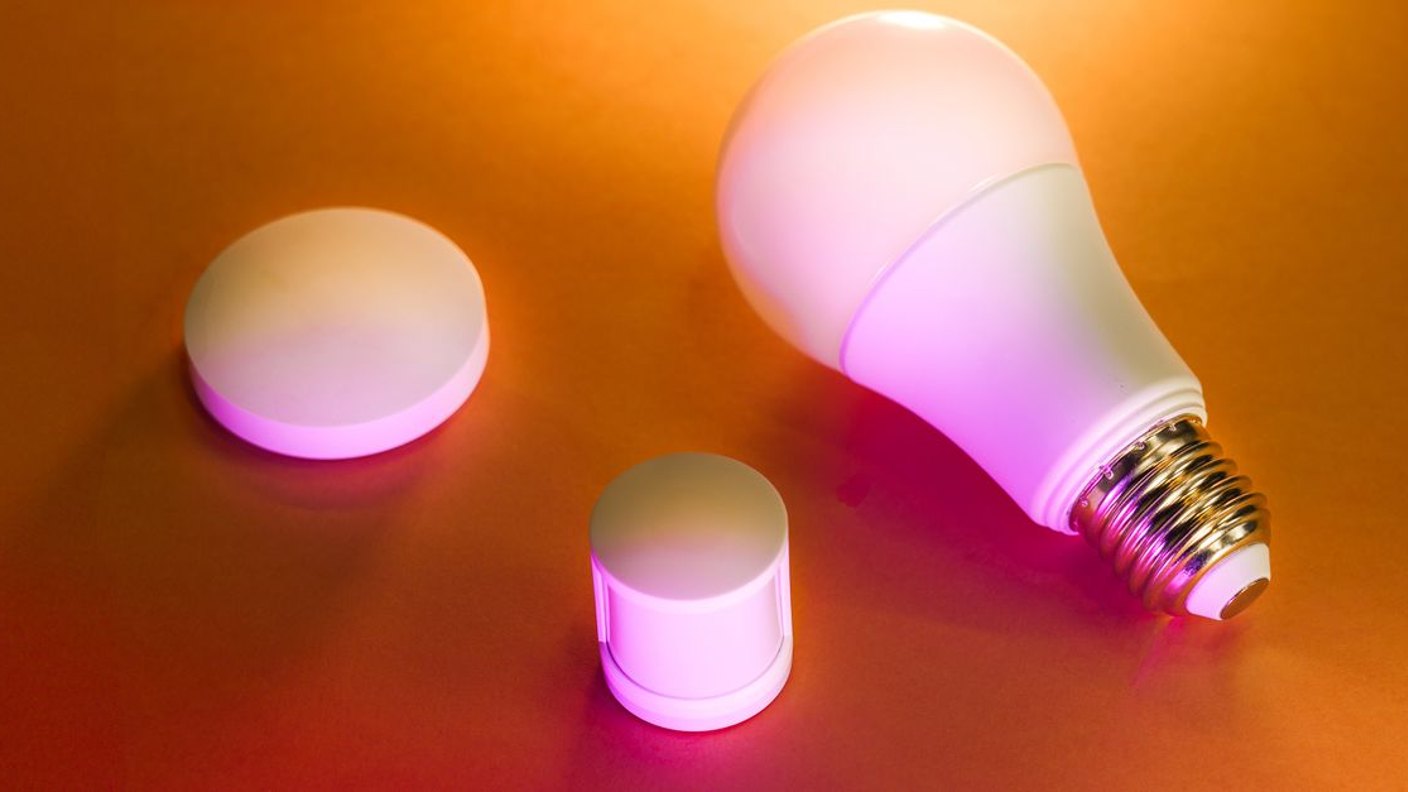
Hue bulbs use Zigbee, a low-power radio that needs a hub, the Hue Bridge, plugged into your router. The bulbs talk to each other and to the Bridge in a mesh, so they don't touch your Wi-Fi at all, and they keep working as a group if the internet goes down. The Bridge costs around $60 on its own; a colour bulb runs roughly $50 to $55 each, white-only about half that.
WiZ bulbs use Wi-Fi. No hub. Each bulb joins your home network directly and talks to the app through Signify's cloud. A colour bulb runs $12 to $18 depending on the pack, white-only under $10. So a four-bulb colour setup is around $270 with Hue including the Bridge, and around $60 with WiZ. That's the gap everyone's asking about.
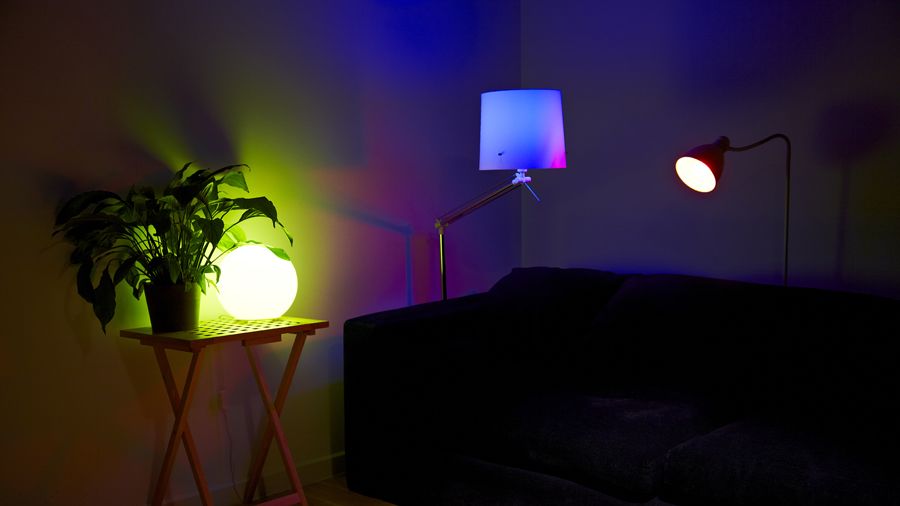
Both do warm white to cool white, both do 16 million colours, both dim, both work with the usual voice assistants, both have scenes and schedules. On paper the feature lists are nearly identical. On the ceiling they aren't.
Setup
WiZ was faster to get started, because there's nothing to plug in. Screw in the bulb, open the app, it finds the bulb, you tell it the Wi-Fi password, done. About two minutes per bulb. Hue needs the Bridge wired to the router first, then the bulbs, which is ten minutes of faffing once and then it's easier from there.
But WiZ setup depends on your Wi-Fi being good in that spot. The bulb in the hallway, which is on the far side of the house from the router, took three tries to join and dropped off twice in the first week. The Hue bulb in the same socket had never dropped once in a year, because it wasn't using Wi-Fi at all, it was talking to the bulb in the next room. That's the mesh doing its job, and it's the single biggest practical difference between the two systems in a house with thick walls.
Light quality, side by side
This is where I expected a big gap and got a small one. I put a Hue and a WiZ in matching lamps either side of the sofa, set both to 2700K at 50 percent, and photographed them every evening for a week.
Warm white: close. The WiZ ran a hair more yellow, the Hue a hair more neutral, and with both dimmed low in the evening I couldn't reliably pick them out. My husband picked the wrong one four times out of six.
Colours: Hue is better. The reds are deeper, the greens less acid, and the transitions between colours are smoother; WiZ steps through changes in a way you can see if you're watching. If you use colour a lot, and I don't, this matters. If you use colour twice a year for a party, it doesn't.
Dimming: Hue goes lower. At the bottom of its range it's a candle; WiZ at its bottom is still clearly a lamp. For a bedroom or a late-evening living room this is the one difference I felt every night. WiZ at its minimum is fine. Hue at its minimum is lovely, and after a year of lovely, fine is a step down.
Flicker: neither flickered to my eye or on the phone camera slow-motion test. Good.
The app, and living with it
The Hue app is the better piece of software. It's faster, the scenes are nicer, rooms and zones are easy, and it hasn't crashed on me in a year. The WiZ app does everything, but it does it a beat slower, with a lag of half a second to a second between tapping and the light responding, which is the cloud round-trip. Hue over the Bridge is instant. You stop noticing the WiZ delay after a fortnight. You notice it again the moment you go back to Hue.
WiZ has one thing Hue doesn't, called SpaceSense, which uses the bulbs' Wi-Fi signal to detect movement in a room and switch lights on. I tried it in the hall. It worked about two-thirds of the time and switched the lights on for the cat about a third of the time. Clever, not reliable enough for me to leave on.
Both work with Alexa, Google, and Apple Home, though Hue's Apple Home support is through the Bridge and rock solid, and WiZ's is newer and, in my house, occasionally showed a bulb as "no response" that was in fact responding. Minor. Worth knowing.
Reliability over six weeks
Hue: zero dropouts across four bulbs. As it has been all year.
WiZ: five dropouts across four bulbs, all in the hallway and the back bedroom, both far from the router. The two bulbs near the router were perfect. So the fair statement is that WiZ is as reliable as your Wi-Fi, and Hue is more reliable than your Wi-Fi. If you have a mesh router system and good coverage, you may never see a dropout. If you have one router in the corner of the house and a bulb three walls away, you will.
When the internet went down for an afternoon in week four, the Hue bulbs kept working from the wall switches and the app on the local network. The WiZ bulbs worked from the wall switch only. That's the hub earning its keep.
Can you mix Hue and WiZ in one house?
Yes, and it's what I ended up doing, but there's a catch worth knowing before you buy. The two systems don't share an app, and they don't share scenes. A "movie night" scene in the Hue app dims the Hue bulbs and does nothing to the WiZ ones; you'd need to build the same scene twice and trigger both, or do it through the voice assistant, which can group bulbs from both systems into one room and one command. That works. It's just a layer of admin the all-Hue household doesn't have.
The other catch is wall switches. Both systems want the wall switch left on and the bulb controlled from the app or voice, and both go dark and stupid if someone flips the switch off. Hue sells a battery dimmer switch that sticks over the wall plate and is the best thing they make; WiZ has a cheaper remote that does the same job with less polish. In the rooms where guests might reach for the wall, I put the sticker over the switch that says "leave on." My mother ignores it.
If you're starting from nothing and know you'll grow, buying one Bridge now and adding Hue bulbs slowly is the tidier path. If you already have a house full of WiZ and you're thinking of upgrading, upgrade the two rooms you sit in at night and leave the rest. The difference is only worth paying for where you'll notice it.
What about the white-only bulbs?
Everything above is about the colour bulbs, because that's what people compare. But the white-only versions are where WiZ's case gets even stronger. A WiZ tunable-white bulb is under $10 and does 2700K to 6500K, dimmable, with schedules. A Hue white ambiance is about $25 plus the Bridge. In a hallway or a porch or over the kitchen sink, the warm white from either is the same to my eye and the WiZ is a quarter of the price.
The one place I'd still pay for Hue white is a bedside lamp, for the dimming floor. At its lowest, a Hue white in the lamp beside the bed is dim enough to read a page by and not wake anyone; the WiZ at its lowest is a notch too bright for that and I found myself turning it off rather than down. Small thing. Every night thing.
Where each one wins
WiZ wins on price by a mile, on setup simplicity, and on the fact that you can try one bulb for $15 and decide. It's the right answer for a rental, for a single room, for a first smart bulb, and for anyone who's going to use warm white 95 percent of the time and just wants schedules and voice control. The warm white is good enough that I'd put it in a guest room and never think about it.
Hue wins on dimming depth, colour quality, app polish, response time, and reliability in a big or awkward house, and it wins by enough that in the rooms I sit in every evening, I put the Hue bulbs back. It's the right answer for a whole-house setup, for anyone who dims low in the evenings, and for anyone who's already been annoyed by a Wi-Fi gadget dropping off the network.
The mixed answer, which is what I actually did
Hue in the living room and bedroom, where the low dimming and the instant response matter. WiZ in the hall, the guest room, the kitchen ceiling, and the porch, where a bulb just needs to come on at dusk and go off at midnight. The two apps don't talk to each other, which is irritating, but both talk to the voice assistant, so in practice I say "lights off" and everything goes off and I don't care which system did it.
Total cost of that setup: Bridge plus four Hue colour bulbs, about $270, plus six WiZ bulbs, about $85. Against ten Hue bulbs, which would have been north of $500. The two rooms that matter get the good stuff. The rooms that don't, don't.
Scores
WiZ: shipping and packaging fine, nothing to report. Build is a plastic bulb; it's a bulb. Value is a 10, there's nothing to argue about. Looks, for the light it makes, an 8; the warm white is properly good. Reliability drags it down a point in my house and might not in yours. Overall 8.1.
Hue I scored at 8.0 on its own, with value as the drag. Side by side with WiZ, value looks even worse and quality looks even better, so I'll leave it where it was. The question was never whether Hue is good. It's whether it's $200 better, and the answer is: in two rooms, yes. In the other six, no.
How I tested
Four Hue colour bulbs and four WiZ colour bulbs, rotated through the same eight sockets over six weeks so each bulb spent time near and far from the router. Warm white compared in matching lamps at 2700K and 50 percent, photographed nightly. Dropouts logged from the apps' own history plus the times I noticed a light not responding. Internet cut deliberately once and once by my provider, unhelpfully. Everything bought with my own money, and the method is in the how I test post. I've also done the wider best smart bulbs roundup if you want the field beyond these two.
Whichever bulb you choose, the fixture matters as much: a bare smart bulb in a ceiling can still look like a bare bulb. Most of mine live in wall sconces and a pendant with a proper shade, which is what turns "smart" into "warm."
WiZ delivers most of what Hue does for a quarter of the price, with warm white that's hard to tell apart. Hue wins on dimming depth, colour, app speed, and reliability far from the router. The sensible setup is Hue in the living room and bedroom, WiZ everywhere else, and a voice assistant to tie them together.